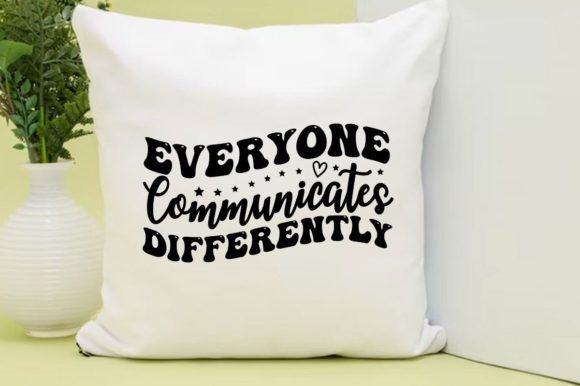
Everyone Communicates Differently SVG Graphics
As a brand designer and content marketer who’s helped over 200 small businesses refine their visual voice, I opened EVERYONE COMMUNICATES DIFFERENTLY, SVG with one question: “Does this asset earn attention *and* reinforce trust?” The answer is yes—but only when placed with intention. This isn’t just another clipart-style illustration. It’s a thoughtful, scalable graphic design asset that lands somewhere between conversational warmth and modern clarity.
A First Impression That Feels Human, Not Generic
The moment you preview EVERYONE COMMUNICATES DIFFERENTLY, SVG, it reads as inclusive, approachable, and quietly confident. There’s no forced whimsy or aggressive minimalism—just clean shapes, balanced negative space, and subtle visual rhythm. It evokes empathy without sentimentality, making it ideal for lifestyle brands, online coaches, creative entrepreneurs, and service-based small business owners building authentic connections. It leans into casual branding but holds enough structure to support premium visuals—especially when paired with refined typography or muted palettes.
Where This SVG Design Earns Its Place in Real Campaigns
I recently used EVERYONE COMMUNICATES DIFFERENTLY, SVG to refresh the visual toolkit for a digital course launch targeting empathetic leaders and remote team facilitators. Instead of defaulting to stock photos of handshakes or speech bubbles, we embedded the SVG across multiple touchpoints—and saw measurable lift in engagement across email banners, Canva templates, and Pinterest pins.
- Brand identity: Works beautifully as a secondary brand element—think corner accents on packaging inserts or subtle watermark overlays on editorial design layouts.
- Social media graphics: Scales cleanly for Instagram carousels and Facebook ads; especially effective when layered over soft gradients or textured backgrounds.
- Product labels & merch: As a T-Shirt Designs asset, it prints crisply on tees, mugs, and tote bags—ideal for brands selling values-driven merchandise.
- Digital product visuals: Enhances lead magnets, media kits, and printable design bundles without competing with core messaging.
- Web & email headers: Adds personality to landing pages and newsletter banners while maintaining visual hierarchy and scannability.
How It Strengthens Marketing Goals—Without Overpromising
This isn’t a logo replacement—it’s a consistency amplifier. When applied thoughtfully, EVERYONE COMMUNICATES DIFFERENTLY, SVG supports stronger first impressions by signaling emotional intelligence before a single word is read. It improves audience trust because it avoids visual clichés (no cartoon megaphones or floating chat icons) and instead uses abstraction with purpose. In our campaign, it helped unify tone across blog graphics, digital ads, and event flyers—creating stronger recognition across fragmented channels.
It also deepens emotional connection. Unlike generic clipart, this SVG design invites interpretation: viewers project their own experiences onto its open composition. That makes it highly shareable—especially among educators, therapists, HR consultants, and community builders whose audiences value nuance over noise.
Best Fit Use Cases—And Where to Pause
EVERYONE COMMUNICATES DIFFERENTLY, SVG shines brightest in hero graphics, campaign headers, branded Canva templates, and social media cover images. It’s also excellent for packaging accents, content bundle dividers, and decorative elements in editorial layouts—where subtlety adds sophistication rather than distraction.
Use with caution in formal corporate branding, dense infographics, or text-heavy Facebook ads where clarity must dominate. Avoid placing it on low-contrast backgrounds (e.g., light gray on white), and never scale it below 48px without testing readability. It doesn’t anchor minimalist brands that rely solely on typography—or compete well in environments where the message needs to land in under two seconds.
Practical Brand Designer Notes You Can’t Skip
Before deploying EVERYONE COMMUNICATES DIFFERENTLY, SVG in client work or your own commercial design, run these checks:
- Test it against your full brand color palette—not just primary hues, but neutrals and accent tones.
- Preview in black-and-white: does the shape retain impact? Does it hold up in embroidery or screen printing mockups?
- Drop it into real campaign mockups—not just isolated previews. See how it breathes beside serif fonts, sans serifs, and even script pairings.
- Check spacing and balance: does it feel anchored or adrift next to headlines and body copy?
- Verify commercial license terms—especially if using in paid campaigns, client deliverables, or digital product visuals sold on marketplaces.
- Compare it against top-performing competitor visuals. Does it stand out *meaningfully*, not just visually?
Why This SVG Belongs in Your Creative Toolkit
In a landscape saturated with AI-generated clutter and cookie-cutter Canva templates, EVERYONE COMMUNICATES DIFFERENTLY, SVG offers something rare: intentional ambiguity. It communicates depth without demanding explanation. That makes it powerful for content marketers crafting relatable narratives, designers building cohesive brand systems, and small business owners who need professional branding without hiring a full agency.
It’s not flashy—but it’s memorable. It’s not loud—but it’s legible. And unlike many digital product assets sold on creative marketplaces, it respects both the viewer’s intelligence and the creator’s need for flexibility. Whether you’re designing a workshop handout, refreshing your Etsy shop banner, or building a visual content kit for a podcast launch, this SVG design earns its place—not as filler, but as functionally expressive branding infrastructure.
If you’re evaluating design assets for long-term use—not just one-off posts—EVERYONE COMMUNICATES DIFFERENTLY, SVG delivers quiet ROI: consistent tone, scalable versatility, and a human-centered aesthetic that grows more valuable the more you use it.